Today’s Guided Scripture on YouVersion features a brief reflection I provided on Isaiah 7:14.
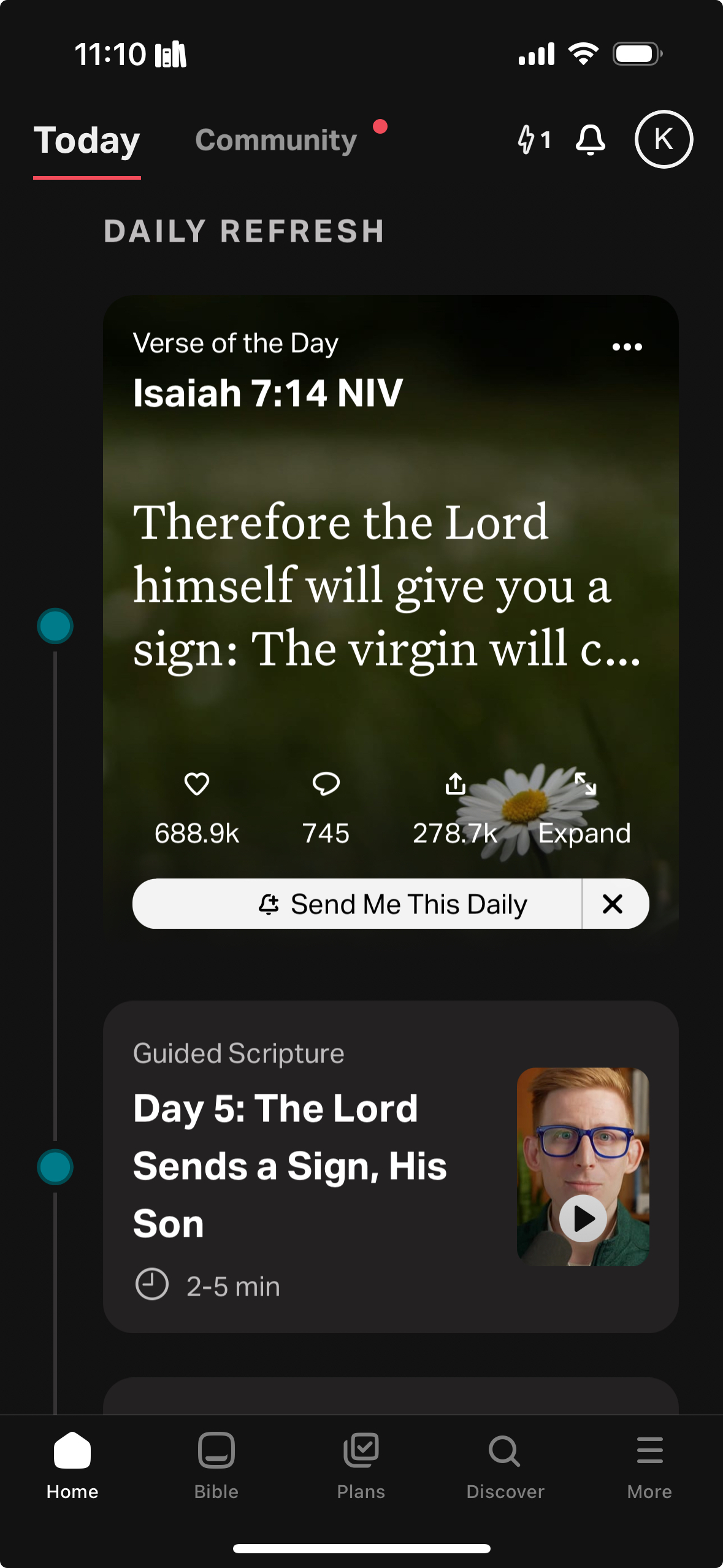
Check it out in the app. 👍🏻
Today’s Guided Scripture on YouVersion features a brief reflection I provided on Isaiah 7:14.
Check it out in the app. 👍🏻
I take no issue with making the gospel central in all things (the church, preaching, the Christian life, etc.)
But one of the results of a malformed gospel-centeredness is a reductionistic theology that treats nearly every issue someone faces as a matter of sin to be dealt with. Sin is always seen, diagnosed, and treated as a root cause. Why? Because if the gospel is the solution to everything, and that gospel is primarily, if not exclusively, understood in terms of addressing sin, then sin is always the issue, and addressing sin with the gospel is always the solution.
I theorize we’re also susceptible due to a simplistic conception of total depravity. We give our doctrine of total depravity what we might call “maximalist” interpretive power. Yes, we are pervasively sinful (Isa 1:6). Total depravity is true. But, along with our simplistic gospel-centeredness, we misconstrue the doctrine of total depravity into a fixation on looking for sin everywhere. We misapply the doctrine of total depravity by searching for sin “behind every bush” and over-spiritualizing situations. But not everything is sin or is to explained by sin—at the very least, not exclusively so.
Added to this, training in pastoral counseling often focuses on teaching pastors how to address sin. So pastors are hardwired to approach situations in terms of sin and sanctification. Those are their default operating categories. The danger is, when you’re a hammer, you start to see everything as a nail.
I call all of this “reductionistic” because it takes true things (e.g., sin and a gospel that addresses it), but embraces these true things at the exclusion of other true things. For instance, someone comes to a pastor in suffering. But, instead of seeing their signs of trauma and affliction for what they are, the pastor diagnoses them as displaying a sinful refusal trust in God, rest in Christ, and obey the call to contentment. Instead of caring for the person and acknowledging their plight, they add insult to injury: they take someone who is suffering, and now further inflict them with wrongful condemnation. Often the suffering is ignored as not the “real” issue. Moreover, the sufferer may be treated as contentious or unrepentant when they (rightly) push back at the bad counsel.
The reality, though, is that humans are both sinners and sufferers. We are not only perpetrators of evil, but also victims to it. We not only sin; we are also sinned against. And the gospel meets not merely our sin but also our suffering. The good news (gospel) is not only that our sin is forgiven, but that Christ will undue the curse in all its effects—including evil and suffering.
This means, for example, that:
We could go on…
Why this matters? Bad theology makes for bad counsel. More pointedly, bad pastoral theology makes for pastoral malpractice—even spiritual abuse.

“Some describe the Gospels as accounts of Jesus’s death with really long introductions. Statements like this can downplay the bulk of the Gospels’ narratives, as though Jesus’s death were the only point of importance and everything else is just preliminary bonus material.
From another vantage point, however, this statement rightly communicates that nothing within the Gospels can be disconnected or properly understood apart from their climactic event: the death and resurrection of Christ. Everything that precedes leads up to the cross and occurs in its shadow.
But is this the case for the Gospel of Luke?”
The following are quotes from Jonathan Leeman and Andy Naselli, How Can I Love Church Members with Different Politics?, 9Marks: Building Healthy Churches (Wheaton, IL: Crossway, 2020),
In the same way that faith creates deeds, so God’s work of justifying a person by grace through faith creates a concern about justice. And in the same way that deeds display and give evidence of faith, so our concern for justice demonstrates and gives evidence for our justification. … Politics involves questions of justice. [Therefore] when fellow Christians disagree with you on significant political matters, you question their commitment to justice, which in turn can sometimes tempt you to question their justification. We’re not saying you’re always right to do so. We’re merely saying it makes sense that this happens. There are theologically correct instincts at play. (14–15)
We are tempted to scorn and second-guess our fellow church members whose politics disagree with ours because every one of us is naturally self-righteous and self-justifying, and fallen politics is fueled by such self-righteousness and self-justification. We’re talking about the basic posture of the fallen heart to always think that it’s right. (15–16)
Are you convinced about your own political opinions? If so, maybe that’s because you are walking in the Spirit, you love your neighbor as yourself, and you have rightly formed judgments about the issues of the day. Then again, it also might be because you are following the self-justifying script of every other political party, of every other tribe and nation, throughout the history of the world. (17)
[T]he anger you feel when people disagree with you politically might be the right response to injustice. But … [t]oo often we use our anger as a weapon to destroy anything that opposes our personalized version of a just universe. We’re self-serving with our anger. (17)
When we were born again, wonderfully, we lost the need to justify ourselves before God through our personal and political pursuits. Christ became our justification. … [W]e become able … to fight for what’s right, not to justify ourselves but for the sake of love. Born-again politics is a different kind of politics. (16)
Most political judgments we make depend on wisdom not on directly applying explicit biblical principles. To put this another way, there is some space between our biblical and theological principles and our specific political judgments. Two Christians might agree on a biblical or theological principle but disagree on which policies, methods, tactics, or timing best uphold that principle. … Political judgments depend on figuring out how to apply our biblical and ethical principles to the vast and complex set of circumstances that surround every political decision. … Remembering this should create some room for charity and forbearance. (18, 21, 24–25)
Personally, we would be shocked if any political party ever felt like a perfect fit for a Christian, as that just might suggest one’s Christianity has been subverted by party thinking. (24)
If you look around and notice that your church is politically uniform, you might ask, Where did it come from? Are there non-biblical pressures to conform to certain class, generational, ethnic, or political-party standards? Is something (besides the gospel) creating that uniformity? If so, might those cultural standards be wrongly binding consciences about what Christians must believe? (26)
Here, then, is a big irony: even if your church is healthy, your members will likely not be entirely uniform in their politics. Your members might even feel some measure of political tension. What unites them is Jesus, not partisan politics. // Unity amid diversity, furthermore, can be a strength of a church’s witness to outsiders. You want outsiders to see your church and think, Wow, you guys love one another across political divides! I’ve never seen anything like that! (26–27)
Jesus did not design our churches to be a national or ethnic or class gathering or the gathering of a political party. Rather, he designed them to be gatherings of his followers from every tribe and tongue and nation. Your church and ours are communities of former enemies learning to love one another. They are communities of political rivals working together. // We are natural-born enemies. Each of us wants to rule. … The local church is where enemy tribes start beating swords into plowshares and spears into pruning hooks. (27–29)
We have his Book. He has revealed himself. That’s amazing, isn’t it? Yet a huge danger looms. We get into a political argument in which we’re telling someone what we think. But we also have a Bible in our hands, and so we begin to blur the lines between what we think and what God thinks. … To avoid confusing our thoughts with God’s thoughts, therefore, we must treat God’s Book with holy reverence and fear. We must take great care to distinguish its authoritative and inerrant wisdom from our own. (44–45)
[S]ometimes the best way to critique the present system and to resist the false worship that so much of politics demands is simply to talk about something else. // Jesus will win. His kingdom does not hang in the balance. Christians who possess this happy confidence can engage with one another amid these secondary political matters while simultaneously enjoying unity and fellowship and hope as they together anticipate the coming of Christ’s perfect reign. (54–55)
How can Christians pray for the upcoming election? Some suggestions:
 Kirk E. Miller