Abridged Bible Reading Plan

The following is an abridged Bible reading plan I developed in ministry at South City Church.

This plan is not intended to replace reading through the entire Bible; but, rather, is to serve as a more accessible starting point for those who are unacquainted with scripture. The hope is that those who use this plan would gain a basic understanding of scripture’s central message along with its key themes, structure, and movements, and, after having done so, would be better equipped to read through the scriptures in their entirety.


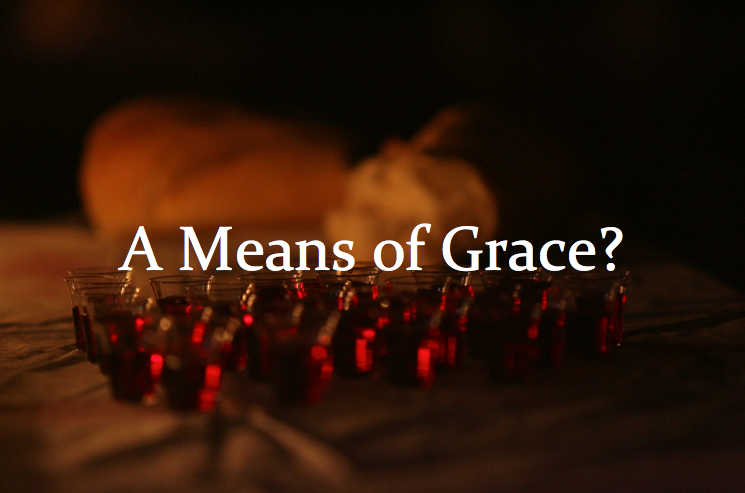
Understanding the Lord’s Supper as a Means of Grace

This past week, at our church plant’s Thursday night gathering, we took some time to talk about the importance of the Lord’s Supper in the life of the believer and the church.

We looked at our philosophy of ministry, which says,

The ordained rites of Baptism and the Lord’s Supper are faith-nourishing signs that tangibly portray Gospel realities to believers. As such, they are not to be neglected, devalued, or misused, but, rather, are to be guarded, administered conscientiously, and cherished as gracious gifts from Christ.

Mt 26:26-28; Mk 14:22-24; Lk 22:19-20; Acts 22:16; Rom 6:3-4; 1 Cor 10:16; 11:23-27; Gal 3:27; Col 2:12; Tit 3:5; 1 Pet 3:21.

I want to follow up on that discussion here in this post.

Often times, in the more baptistic, non-denominational, believers’-church-tradition circle in which I find myself, the Lord’s Supper is seen as nothing more than a cognitive aid for rehearsing the sacrificial death of Jesus. We call this the memorial view of the Supper: the Supper is a means of remembering (hence “memorial”) the death of Christ.

Now, I don’t want to downplay the importance of simply remembering Christ’s work on our behalf. But I do want to ask, What is that “remembering” suppose to look like and involve? What does the New Testament have in mind when it talks of this “remembering.” Is it merely a recall, a cognitive exercise like running scenes from the Passion of the Christ in your head? Or is it something more like what we refer to today as “preaching the truths of the Gospel to yourself”?

Continue reading

“Seek God in Scorn of the Consequences” (John Stott)

In seeking God [i.e., to consider God, his actions, and his self-revelation as recorded in scripture with a genuine willingness to accept what one finds] we have to be prepared not only to revise our ideas but to reform our lives. If the Christian message is true, the moral challenge has to be accepted. So God is not a fit object for man’s detached scrutiny. You cannot fix God at the end of a telescope or a microscope and say ‘How interesting!’ God is not interesting. He is deeply upsetting. The same is true of Jesus Christ.

‘We had thought intellectually to examine him [Jesus]; we find he is spiritually examining us. The roles are reversed between us… We study Aristotle and are intellectually edified thereby; we study Jesus and are, in the profoundest way, spiritually disturbed. … We are constrained to take up some inward moral attitude of heart and will in relation to this Jesus. … A man [or woman] may study Jesus with intellectual impartiality, he cannot do it with moral neutrality. … We must declare our colours. To this has our unevasive contact with Jesus brought us. We begin it in the calm of the study; we are called out to the field of moral decision [Carnegie Simpson, The Fact of Christ, 23-24].’

We have to be ready not just to believe, but to obey. We must be prepared to do God’s will when he makes it known. … This, then, is the spirit in which our search must be conducted. We must … seek God in scorn of the consequences.

[The hindrance to this sort of search is fear.] Fear is the greatest enemy of truth. Fear paralyses our search. We know that to find God and to accept Jesus Christ would be a very inconvenient experience. It would involve the rethinking of our whole outlook on life and the readjustment of our whole manner of life. …

We do not find because we do not seek. We do not seek because we do not want to find, and we know that the way to be certain of not finding is not to seek.

John Stott, Basic Christianity, 17-18.

Ecclesiastes: What’s This Life All About? (Grace Bible Church)

The following are my notes / outlines from a series of talks I did on the book of Ecclesiastes for the teen retreat at Grace Bible Church in Boise, Idaho.