Explanation
 On Sunday, January 24th, 2016, I began a Core Seminar on Redemptive History & Biblical Theology at my church, Lake Drive Baptist Church. During the course of this series I’ll be sending out emails recapping lessons and directing recipients to resources for further study.
Rather than just share these recaps with my church family, I’ve decided to share them here on the blog for anyone else who might be interested. I will be posting them occasionally over the next couple of months on a weekly basis or so.
See previous posts:
- Introducing Biblical Theology and Redemptive History (LDBC Recap 1/24/16)
- The Significance and Relevance of Biblical Theology and Redemptive History (LDBC Recap 1/31/16)
- Foundational Principles and Basic Frameworks for Redemptive History and Biblical Theology (LDBC Recap 2/7/16)
- Redemptive-Historical, Biblical-Theological Hermeneutics (LDBC Recap 2/14/16 Pt. 1)
- Redemptive-Historical Survey: 1 | Creation (LDBC Recap 2/14/16 Pt. 2)
- Redemptive-Historical Survey: 2 | The Fall (LDBC Recap 2/21/16)
- Redemptive-Historical Survey: 3 | The Flood & Noahic Covenant (LDBC Recap 2/28/16)
- Redemptive-Historical Survey: 4 | Abrahamic Covenant & the Patriarchs (LDBC Recap 3/6/16 Pt. 1)
- Redemptive-Historical Survey: 5 | The Exodus (LDBC Recap 3/6/16 Pt. 2)
- Redemptive-Historical Survey: 6 | The Mosaic Covenant (LDBC Recap 3/13/16)
- Redemptive-Historical Survey: 7 | The Wilderness Wanderings (LDBC Recap 3/20/16, Pt. 1)
Recap/review
We continue this week’s core seminar recap by reviewing the role of Israel’s entrance and initial life in the Promised Land in redemptive history.
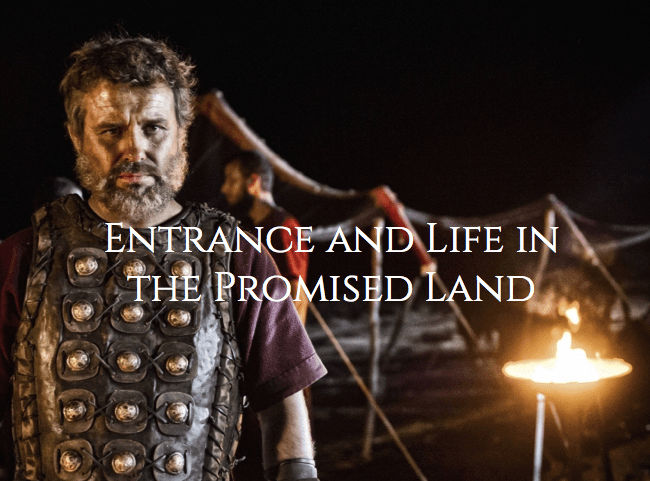
Overview of Biblical material
Joshua, Judges, Ruth.
- After the wilderness Generation died, Moses preaches the Law at the edge of the promised land (Deuteronomy). He prepare the next generation to enter the land.
- The torch of national leadership is passed from Moses to Joshua.
- Joshua leads the people into the land and they/God conquer.
- Joshua distributes the land, much of which is yet to be conquered, to the twelve tribes.
- But, although the land is promised to them, the tribes fail to fully possess the land given to them. Many of its original inhabitants are left.
- Israel’s leadership enters into a stage of judges (e.g., Ehud, Barak, Gideon, Samson, etc.), who are far from godly leaders.
- The time-period of the judges is characterized by…
-
- (1) A lack of political stability:
-
- No centralized government.
- No king.
- Israel is a group of loosely connected tribes.
- Repeated oppression from surrounding nations.
- (2) A lack of moral stability:
Sum: “In those days there was no king in Israel. Everyone did what was right in his own eyes” (Judges 21:25).
- Israel repeats a cycle (see Judges 2:6-23):
-
- (1) Disobedience/idolatry.
- (2) Divine punishment in terms of oppression of nearby nations.
- (3) Israel’s cry to God for help.
- (4) God raising up a judge and providing deliverance.
Role within redemptive history
So, now, as always, we want to ask, how does this episode fit into redemptive history? How does this initial entrance and life in the land relate to God bringing about his covenant-bound new-creational kingdom purposes?
We can summarize its place as follows: Although God is faithful to his covenant-bound purposes to bring about his new-creational kingdom, God’s people only experience a partial realization of it due to disbelieving disobedience. Continue reading


 Kirk E. Miller